

Fear & Greed Index
Latest Market News
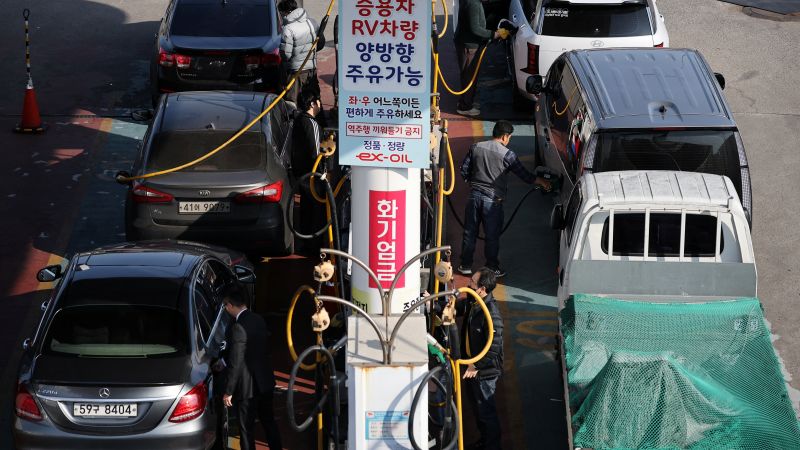
Gas stations are rationing fuel. Hospitals are running out of medical supplies. People are hoarding plastic bags, and factories face packaging shortages.
That’s allhappening in Asia now.
That could become a problem for the United States: Abouthalf the stuffAmericans buy comes from Asia.
If Asian factories are dealing with a lack of supplies, should Americans expect shortages, too?
Possibly – but not just yet. At least not in any widespread or severe manner. But the longer the Strait of Hormuz remains closed, the harder it will become for the United States to avoid the problems piling up elsewhere.
Certainly, the red flags are waving.
War with Iran has threatened the world’s supplies of aluminum, plastics and rubber in particular. The Middle East ships about 25% of the world’s polypropylene and 20% of polyethylene, two of the most-used plastics. It also accounts for a quarter of the world’s sulphur and 15% of its fertilizer.
“You hear a lot about crude oil and the impacts to diesel and gasoline – but feedstocks and petrochemicals are in short supply, too,” said Angie Gildea, KPMG global head of oil and gas.
Several major petrochemical producers, includingSouth Korea’s YeochunandPCS in Singapore, have declared “force majeure,” noted Stephen Brown, chief North American economist at Capital Economics. That means they’re unable to fulfil their commitments to customers.
Other companies say they’re running out of plastic packaging for their products. Acondom makersaid Tuesday that prices would surge because it can’t access manufacturing materials.
The S&P 500’s global supply shortages indicator, a key measure of major companies’ reports of supply constraints, has shot higher in recent weeks, creeping above its long-term average for the first time in three years.
“We’re [the United States] more exposed than we realize,” said Ross Mayfield, an investment strategist at Baird.
Unlike tariffs, which Trump telegraphed months in advance, the war surprised many companies and gave them little time to prepare – particularly businesses heavily reliant on Asian goods.
“Tariffs were levied by the administration and could be pulled back by the administration,” noted Mayfield. “It’s much harder to extricate America from this cleanly.”
Repeated fits and starts with negotiations between the United States and Iran suggest no end in sight to the closure of the strait. Kpler forecasts oil supply losses from the strait closure will total 700 million barrels by the end of April.
Those oil shortages could lead to US goods shortages down the road, Gildea said.
For example, fuel shortages in Asia could hinder factory employees from getting to work, Gildea said, potentially slowing export production.
Supply shortages probably won’t approach pandemic levels, Brown said. But time is not our friend. The oil and gas industry expects widespread shortages across multiple categories of goods if the strait remains closed heading into the summer, Gildea said.
“The length of this is everything now,” said Mayfield.
The US economyisfeeling pressure from the war in the Middle East – mainly through higher oil and gas prices. But only a tiny fraction (roughly 7%) of US energy imports ship through the Strait of Hormuz, according to theUS Energy Information Administration. The US produces the bulk of its energy at home.
“Thus the story for the US is mainly about prices rather than availability,” noted Nathan Sheets, global chief economist at Citigroup.
The last shipments of energy products from the Middle East from before the war just arrived in Asia, so it will take time for shortages to grow severe enough that factories need to make major adjustments to their production.
It’s hard to put a precise timeframe on how long the disruption in the strait would need to last to trigger supply shortages in the United States, Brown noted. Plastics and especially aluminum aren’t warehoused in large supplies.
Still, Brown predicted it could take three months for plastic shortages to spread around the world and four months until automakers need to cut production because of aluminum shortages.
Companies hardened and diversified their supply chains following the pandemic and during Trump’s recent tariff campaign, insulating US importers from some of the disruptions they’d otherwise have faced sooner.
And world trade was in good shape just ahead of the war: US tariffs fell afterthe Supreme Court knocked down the bulk of Trump’s import taxes. Global exports gained a bit in February, and early March data seems solid so far – even out of Asia, although that could be because demand for Chinese electric vehicles grew.
That could change.
“Clearly a lot that could go wrong if the strait isn’t properly re-opened,” Brown noted.
Most stock quote data provided by BATS. US market indices are shown in real time, except for the S&P 500 which is refreshed every two minutes. All times are ET. Factset: FactSet Research Systems Inc. All rights reserved. Chicago Mercantile: Certain market data is the property of Chicago Mercantile Exchange Inc. and its licensors. All rights reserved. Dow Jones: The Dow Jones branded indices are proprietary to and are calculated, distributed and marketed by DJI Opco, a subsidiary of S&P Dow Jones Indices LLC and have been licensed for use to S&P Opco, LLC and CNN. Standard & Poor’s and S&P are registered trademarks of Standard & Poor’s Financial Services LLC and Dow Jones is a registered trademark of Dow Jones Trademark Holdings LLC. All content of the Dow Jones branded indices Copyright S&P Dow Jones Indices LLC and/or its affiliates. Fair value provided by IndexArb.com. Market holidays and trading hours provided by Copp Clark Limited.
© 2026 Cable News Network. A Warner Bros. Discovery Company. All Rights Reserved.CNN Sans ™ & © 2016 Cable News Network.
Scan the QR code to download the CNN app on Google Play.
Scan the QR code to download the CNN app from the Apple Store.
By clicking "Agree", you have read and agree to theTerms of Useand agree to the collection and use of your information by cookies and similar technologies, as set forth in ourPrivacy Policy.