
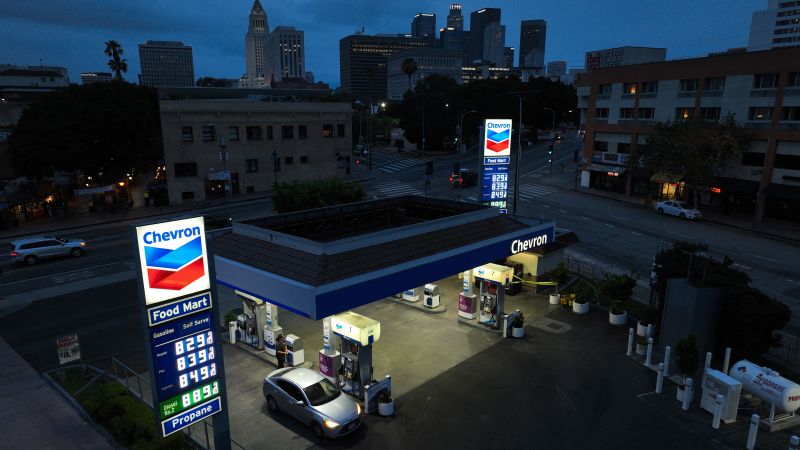

This won’t sit well with Americans watching pump numbers whirl as they gas up their cars.
But the Trump administration is arguing that an obscure concept best known to speculators proves the Iran war’seconomic shockis nearly over.
It’s called backwardation.
This is the arcane term for when the price of a commodity on the futures market grows more expensive the sooner it’s set to be delivered — and cheaper the later it’s set for delivery. Futures markets allow traders to lock in a number now for something they’ll buy or sell in months to come.
It sounds like a long shot. But it might be the best the administration has to go on as it seeks to stave off a Republican meltdown in themidterm elections. Treasury Secretary Scott Bessent put on his former hedge fund manager’s hat to try to convince senators Wednesday that the future was rosy.
“It is my belief that when we talk about gasoline, that thecrude marketis currently in what is known in the energy business as a very steep backwardation — which means that the future prices are much lower than we are at present.” Bessent said. “I think the conflict will end. I think gasoline prices will come back to where they were or perhaps lower.”
There are three issues with Bessent’s approach.
First, using financial jargon when gas is averaging $4 a gallon nationwide only epitomizes the tin ear that the administration has developed on affordability — the top voter issue ahead of November. Cabinet officials and the president, who lead wealthy lives far beyond the experience of regular citizens, sound indifferent when diagnosing daily struggles of Americans this way.
Second, Bessent’s argument may be fine in itself, but it doesn’t add up when Trump is yet to make good ondozens of promisesthat a war now in its eighth week is about to end. Democratic Sen. Jack Reed, who challenged Bessent on the economy in a Senate Appropriations Committee hearing, has expertise on this point from another of his assignments. “From a perspective of the Armed Service Committee, it’s not likely to end soon,” he told the Treasury secretary.
Third, backwardation may not be the savior Trump’s looking for. One explanation for current conditions is that traders worry there won’t be enough oil going forward, so they are trading out of futures contracts down the road and into futures contracts that deliver oil sooner. (That’s also why some traders are rushing to buy real barrels of the black stuff on the physical market, ditching paper futures contracts altogether.)
Backwardation may just be a measure of the current crisis. If the Strait of Hormuz remains closed, thingscould well get worse.
Bessent’s Senate seminar on Wednesday was emblematic of both the grave economic problems caused by the Iran war and the administration’s inability to tell people when relief will be at hand.
But the political problem predates the war. Trump has long struggled to show empathy to millions of Americans who are struggling to afford grocery and housing prices. His failure is exacerbated by memories of his boasts in the 2024 campaign that he’d quickly fix such issues. And more broadly, the president is struggling to handle a conundrum with which many of his predecessors wrestled: how to claim credit for the good parts of an economy millions of voters nevertheless believe is not working for them.
Gas prices are the most tangible, and dangerous, economic red light when elections loom. Everyone knows the ache caused by high numbers on gas station signs. Americans who drive significant miles to get to work each week experience a painful tightening of budgets when prices are high.
The administration hastied itself in knotsover gas in recent days. On Sunday, Energy Secretary Chris Wright told CNN’s Jake Tapper that it might be some time before gas prices are back under $3 a gallon. “That could happen later this year,” Wright said. “That might not happen until next year.”
Wright’s candor didn’t go down well with Trump, who said his Cabinet secretary was “totally wrong” in a later interview with “The Hill.”
But Trump has been all over the map, too. On April 12, he told Fox gas prices might not come down before November’s midterms. But days later, he said they will be “much lower” before the election.
Bessent’s record might also cast some doubt on his backwardation theory. He said on April 15 he was optimistic that by September 20 “we can have $3 gas again.” But he then qualified his remark to mean a cost per gallon of between $3.00 and $3.99.
The administration’s mixed messaging on gasoline seems unlikely to ease its political problems over the economy.
Just over six months before the congressional elections, Americans are in a terrible mood on prices. Time is running out for the administration to fix it before perceptions solidify over the summer.
Trump’s approval rating on the economy has fallen to a new career low of 31%, according to new CNN/SSRS poll data released on April 1. This is notable since memories of Trump’s pre-Covid economy went a long way to assuring his reelection in 2024, after the inflation-plagued Biden administration. People are not just unhappy; they think Trump is making things worse. Roughly two-thirds of Americans say Trump’s policies have worsened economic conditions in the US, up 10 points since January.
Phil Mattingly discusses why life is getting more expensive
Trump has hardly helped himself. White House efforts to highlight agenda items to make lives better — like attempts to lower the costs of certain prescription drugs and to make housing more affordable — have been sporadic. The president has mocked efforts by aides to make him stick to his script when he hits the road to talk about the economy.
A potential good news story about higher tax refunds and new allowances on earnings like tips were drowned out on tax day by grim war news and high gas prices. And Trump’s bizarre pre-Christmas address, in which he appeared to rebuke those who don’t recognize his self-declared “golden age,” created a gulf with voters’ lived experience. So did his recent comments that gas prices hadn’t gone as high as he expected during the war.
Trump is learning what his predecessors knew.
It’s one thing to use affordability as a political weapon in a campaign. But then the issue becomes a curse of incumbents. President Joe Biden found this out when his administration never really recovered from inflation that spiked to the highest levels since the 1980s after the pandemic. Officials’ assurances that high prices were “transitory” created a similar sense of indifference to that often projected by Trump.
Both Biden and Trump had another common experience: Despite specific economic problems, the US economy has been resilient on their watches. While there are many current warning signs, job growth has been steady but not spectacular; inflation is a worry, but was still only 3.3% annually in March; and years of predictions of imminent recessions have not panned out.
But voter frustration goes deeper than periodic spurts of attention to “affordability” suggest. It’s a result of years of grinding struggles for working- and middle-class Americans, who face a constant battering of costs for housing, food, college, health care and elder care.
Midterm elections are especially perilous for presidents when voters perceive economic duress — making the choice of language especially important. In 2010, President Barack Obama needed to claim credit for rescuing the economy after the Great Recession but struggled with how to acknowledge the pain many voters were still feeling. He came up with a line in his speeches to warn voters that Republicans “drove the economy into a ditch” and now wanted the keys back. “You can’t have the keys back. You don’t know how to drive!”Obama would say.
It didn’t work. Republicans gained 63 seats in the midterms and won back the House, in what the 44th president called a “shellacking” brought on because “people all across America aren’t feeling that progress.”
Just like Obama, Trump and Bessent are compelled by politics to concoct rationales for optimism and to argue things that are not as bad as they seem. But language that conflicts with the evidence of voters’ lives rarely works.
© 2026 Cable News Network. A Warner Bros. Discovery Company. All Rights Reserved.CNN Sans ™ & © 2016 Cable News Network.
Scan the QR code to download the CNN app on Google Play.
Scan the QR code to download the CNN app from the Apple Store.
By clicking "Agree", you have read and agree to theTerms of Useand agree to the collection and use of your information by cookies and similar technologies, as set forth in ourPrivacy Policy.